Size, distance and gravity
A pea next to a nickel, 30 Earths away, with one-sixth of the pull. Here’s the Moon in numbers.
How big?
Put a green pea next to a US nickel (a 5-cent coin) and you have a good idea of the size of the Moon compared to Earth. NASA Science: Moon facts With a radius of about 1,740 km, the Moon is less than a third of the width of Earth. NASA Science: Moon facts
The Moon’s mean radius is 1,737.4 km. Earth’s is 6,371.0 km. NASA NSSDC: Moon fact sheet Earth is 3.7 times bigger across than the Moon. NASA Science: Earth and the Moon, by the numbers
The Moon has 0.0123 times Earth’s mass: Earth is about 80 times heavier. NASA NSSDC: Moon fact sheet
How far?
The Moon is an average of 384,400 km from Earth: room for 30 Earth-sized planets in between. NASA Science: Moon facts
At its closest the Moon is 225,309 miles away, and at its farthest 251,903 miles. NASA Space Place: How far away is the Moon?
On NASA’s fact sheet, the Moon’s closest point (perigee) is 363,300 km and its farthest (apogee) 405,500 km. NASA NSSDC: Moon fact sheet
Drifting away
The Moon is slowly moving away from Earth, by about an inch (3.8 cm) a year. NASA Science: Moon facts NASA’s fact sheet gives the Moon’s recession rate as 3.8 cm a year. NASA NSSDC: Moon fact sheet
Going round
The Moon takes 27.3217 days to go once around Earth. NASA NSSDC: Moon fact sheet From one new Moon to the next takes 29.53 days, a little longer, because Earth is moving around the Sun at the same time. NASA NSSDC: Moon fact sheet
Because Earth and the Moon are both moving around the Sun, it takes a little more than two extra days for sunlight to hit the Moon the same way again. NASA Science: Top Moon questions
The Moon travels around Earth at an average of 1.022 km per second. NASA NSSDC: Moon fact sheet
The same face, always
The Moon spins once on its axis in the same time it takes to go once around Earth, so the same side always faces us. NASA Science: Moon facts
The Moon seems to nod and roll slightly over a month, so over time we can peek a little way round its edges. This is called libration. NASA Science: Moon phases
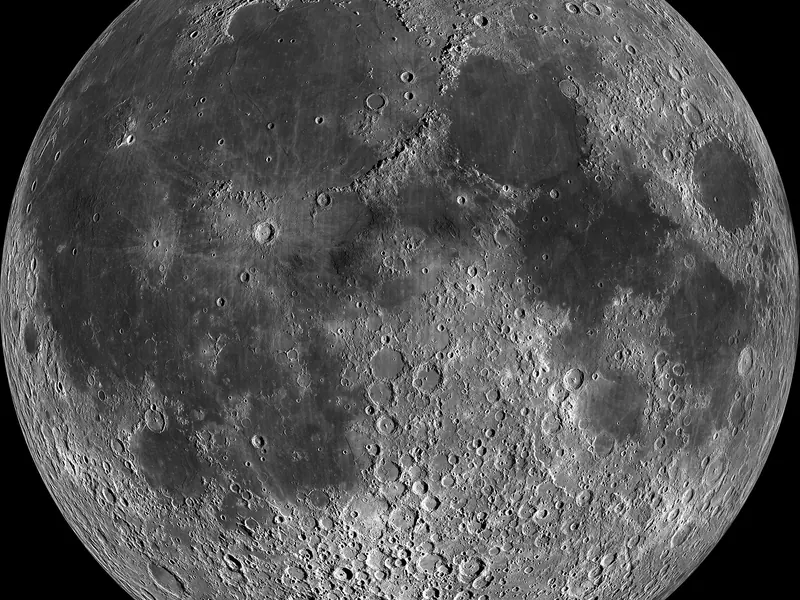
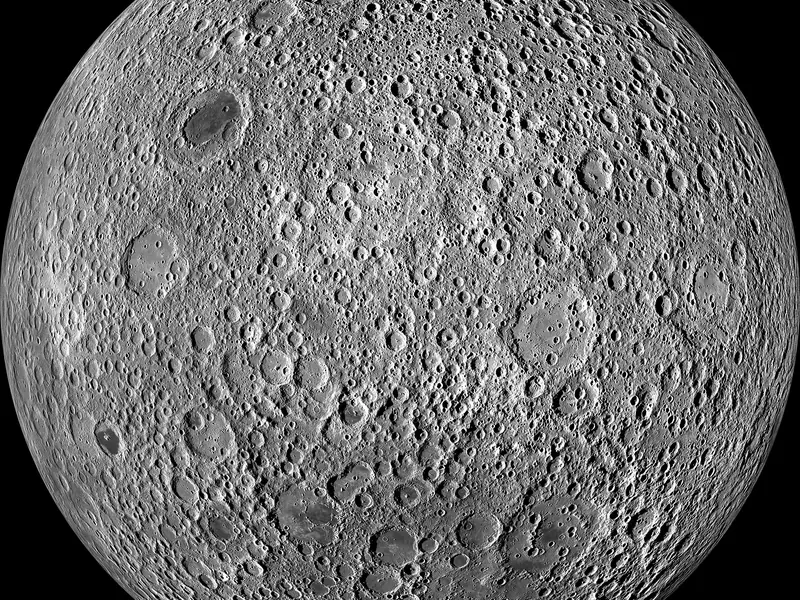
The far side looks different from the near side. It has far fewer dark areas. NASA Space Place: All about the Moon
Gravity
Gravity on the Moon is one-sixth of Earth’s, which is why astronauts seem to bounce. NASA Science: Moon facts Surface gravity on the Moon is 1.62 m/s², compared with 9.80 m/s² on Earth: a ratio of 0.165. NASA NSSDC: Moon fact sheet
On the Moon you’d be able to jump about six times as high as on Earth, but you’d still come back down. NASA Science: Top Moon questions
To escape the Moon’s gravity you need 2.38 km per second. On Earth it’s 11.2 km per second. NASA NSSDC: Moon fact sheet
Want your Moon weight? Try the birthday Moon →
Air and temperature
The Moon has only a very thin atmosphere called an exosphere. You couldn’t breathe it. NASA Science: Moon facts
In full Sun the Moon’s surface reaches about 127 °C, and in darkness it falls to about −173 °C. NASA Science: Moon facts In deep, permanently shadowed craters near the poles, LRO has measured temperatures lower than −246 °C. NASA Science: Weather on the Moon
The Moon spins once on its axis every 655.720 hours: that’s about 27.3 Earth days. NASA NSSDC: Moon fact sheet
Inside the Moon
The Moon probably formed after a Mars-sized body crashed into the young Earth. Debris from both came together to make the Moon. NASA Science: Moon facts That happened about 4.5 billion years ago, near the time the solar system formed. NASA Science: How the Moon formed
The object is often called Theia, after the Greek Titan who was mother of Selene, goddess of the Moon. NASA Science: How the Moon formed
The new Moon was molten. Within about 100 million years most of its ‘magma ocean’ had set solid. NASA Science: Moon facts The Moon has a solid, iron-rich inner core 240 km in radius, inside a liquid iron shell 90 km thick. NASA Science: Moon facts
The crust is about 40 km thick on the near side and up to about 60 km on the far side. NASA Science: Moon facts The Moon’s density is 3.344 g/cm³, against 5.513 for Earth. NASA Science: Earth and the Moon, by the numbers
Today the Moon has only a very weak magnetic field. Earth’s is many thousands of times stronger. NASA Science: Moon facts
Moonquakes
The Moon has moonquakes. Seismometers left by Apollo astronauts recorded them. NASA Science: Moonquakes Shallow moonquakes can reach 5.5 on the Richter scale and last more than 10 minutes. NASA Science: Moonquakes
Long ago the Moon had active volcanoes. Today they’re all dormant and haven’t erupted for millions of years. NASA Science: Moon facts
What it does for us
The Moon’s gravity keeps Earth from wobbling on its axis too much, which helps to keep our climate steady. NASA Science: Top Moon questions
Its name
Our Moon is just called “the Moon” because nobody knew other moons existed until Galileo Galilei discovered four moons orbiting Jupiter in 1610. NASA Science: Moon facts In Latin, the Moon was called Luna. That’s where our word “lunar” comes from. NASA Science: Moon facts
The Moon has no moons of its own, and no rings. NASA Science: Moon facts
Most Moon numbers here come straight from NASA’s Moon facts page and NASA’s Moon fact sheet. Different NASA pages sometimes round differently (for example, the hottest daytime temperature is “127 °C” on one NASA page and “over 121 °C” on another, and Tycho Crater is “more than 85 km” wide on one and “about 82 km” on another). We use the Moon facts page and the fact sheet. Mission counts change, so they carry the date we checked them.