Why the Moon changes shape
Half the Moon is always lit by the Sun. What changes is how much of that half we can see. And the same pull that keeps it going round moves the oceans.
The eight phases
The eight phases, in order, are: new Moon, waxing crescent, first quarter, waxing gibbous, full Moon, waning gibbous, third quarter and waning crescent. NASA Science: Moon phases
- New Moon
- Waxing crescent
- First quarter
- Waxing gibbous
- Full Moon
- Waning gibbous
- Third quarter
- Waning crescent
Drawn as seen from the Northern Hemisphere. In the Northern Hemisphere a waxing crescent is lit on the right, and a waning crescent on the left. NASA Space Place: What are the Moon’s phases?
What causes them
The Sun always lights up half of the Moon. Phases are how much of that lit half we can see from Earth. NASA Science: Moon phases The Moon doesn’t make its own light. Moonlight is sunlight reflected off the Moon’s surface. NASA Science: Top Moon questions
Phases are not caused by Earth’s shadow. The only time Earth’s shadow affects how the Moon looks is during a lunar eclipse. NASA Science: Top Moon questions
How long it takes
From one new Moon to the next takes 29.53 days, a little longer, because Earth is moving around the Sun at the same time. NASA NSSDC: Moon fact sheet Because Earth and the Moon are both moving around the Sun, it takes a little more than two extra days for sunlight to hit the Moon the same way again. NASA Science: Top Moon questions
NASA’s phase tables give the average time from new Moon to new Moon (for the year 2000) as 29.530588 days: 29 days, 12 hours, 44 minutes and 3 seconds. NASA GSFC: Phases of the Moon, 2001 to 2100 (F. Espenak) Any one month from new Moon to new Moon can be anywhere from 29.26 to 29.80 days long, because of the Sun’s pull on the Moon’s oval orbit. NASA GSFC: Phases of the Moon, 2001 to 2100 (F. Espenak)
Find the phase on any date from 1901 to 2100, from NASA’s own tables: try the birthday Moon →
Everyone sees the same Moon
Everyone on Earth sees the same phase of the Moon. In the other hemisphere it just looks upside down. NASA Science: Top Moon questions
You can often see the Moon in the daytime. It’s up just as much in the day as at night. NASA Science: Top Moon questions A full Moon rises around sunset and sets around sunrise. NASA Science: Moon phases
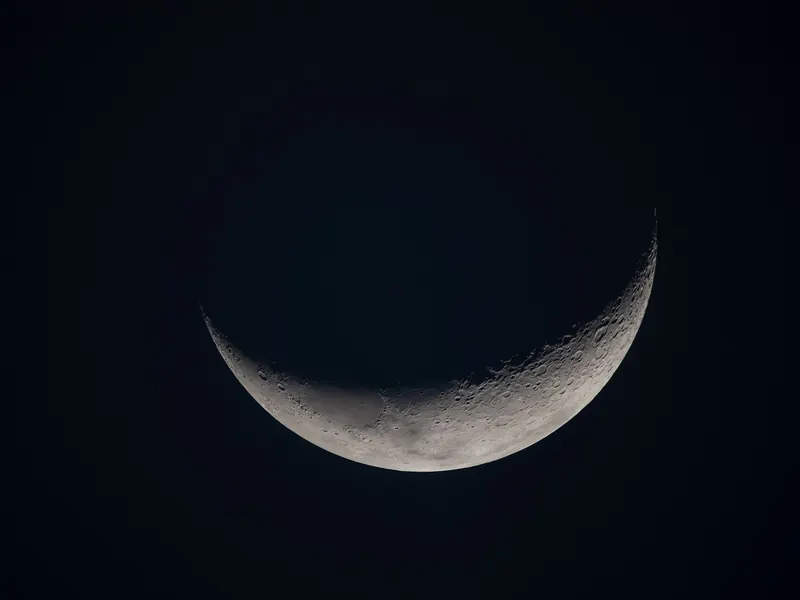
Earthshine
Earthshine is sunlight bouncing off Earth onto the dark part of the Moon. It makes the ‘unlit’ part of a crescent Moon glow faintly. NASA Science: Moon phases
Supermoons and the horizon Moon
A ‘supermoon’ is a full Moon when the Moon is near its closest point to Earth. It isn’t an official astronomical term. NASA Science: Supermoons At its closest, a full Moon can look up to 14% bigger and 30% brighter than the faintest full Moon of the year. NASA Science: Supermoons
The Moon looks bigger near the horizon, but that’s an optical illusion. NASA Science: Top Moon questions
Tides
The Moon’s gravity is the main cause of Earth’s ocean tides. NASA Science: Tides Most coasts get two high tides and two low tides a day. High tide to high tide takes a little over 12 hours. NASA Science: Tides
Spring tides (extra-high and extra-low) happen around new and full Moon, when the Sun, Moon and Earth line up. They’ve nothing to do with spring. NASA Science: Tides Gentler neap tides happen around the first and last quarter Moons. NASA Science: Tides
The Sun has about 27 million times the Moon’s mass, but it’s about 390 times farther away, so it has a little less than half the Moon’s tide-raising power. NASA Science: Tides
Earth has 80 times the Moon’s mass. NASA Science: Tides Earth raises tides in the solid Moon too: about 10 to 15 cm. NASA Science: Tides
Eclipses
An eclipse of the Sun can happen only at new Moon, and an eclipse of the Moon only at full Moon. NASA GSFC: Phases of the Moon, 2001 to 2100 (F. Espenak) There isn’t a solar eclipse at every new Moon: because the Moon’s orbit is tilted, it doesn’t usually pass directly between Earth and the Sun. NASA Science: Moon phases
The Moon’s orbit is tilted about 5 degrees compared with Earth’s path around the Sun. NASA Science: Lunar eclipses
In a lunar eclipse the Moon can turn red, because the only sunlight reaching it has been filtered through Earth’s atmosphere. NASA Science: Lunar eclipses
Every calendar year has at least two solar and two lunar eclipses, and at most 7 eclipses in all. NASA GSFC: Phases of the Moon, 2001 to 2100 (F. Espenak)
NASA’s phase tables also mark each eclipse: T total, A annular, H hybrid and P partial for the Sun; t total, p partial and n penumbral for the Moon. NASA GSFC: Phases of the Moon, 2001 to 2100 (F. Espenak)
Next: the surface →