Things everybody “knows” about the Moon
A dark side that isn’t, a horizon Moon that doesn’t grow, and seas without a drop in them. Gently corrected.
Myth The far side of the Moon is always dark.
Fact There is no permanent dark side of the Moon. The far side gets as much sunlight as the near side. NASA Science: Top Moon questions At new Moon, it’s daytime on the far side. NASA Science: Moon facts
Myth The Moon makes its own light.
Fact The Moon doesn’t make its own light. Moonlight is sunlight reflected off the Moon’s surface. NASA Science: Top Moon questions Only about a tenth of the sunlight that hits the Moon bounces back. From Earth it looks bright, almost white, but much of its surface is really shades of dark grey. NASA Science: Moonlight
Myth The phases are caused by Earth’s shadow.
Fact The Sun always lights up half of the Moon. Phases are how much of that lit half we can see from Earth. NASA Science: Moon phases Phases are not caused by Earth’s shadow. The only time Earth’s shadow affects how the Moon looks is during a lunar eclipse. NASA Science: Top Moon questions
Myth The Moon is bigger when it’s near the horizon.
Fact The Moon looks bigger near the horizon, but that’s an optical illusion. NASA Science: Top Moon questions
Myth People in Australia see a different phase.
Fact Everyone on Earth sees the same phase of the Moon. In the other hemisphere it just looks upside down. NASA Science: Top Moon questions
Myth The Moon’s ‘seas’ are full of water.
Fact The dark patches are called maria, Latin for ‘seas’. They’re huge basins that filled with lava between 4.2 and 1.2 billion years ago. NASA Science: Moon facts The Moon’s ‘seas’ aren’t water. They’re old lava. NASA Space Place: All about the Moon
Myth The Moon doesn’t spin.
Fact The Moon spins once on its axis in the same time it takes to go once around Earth, so the same side always faces us. NASA Science: Moon facts
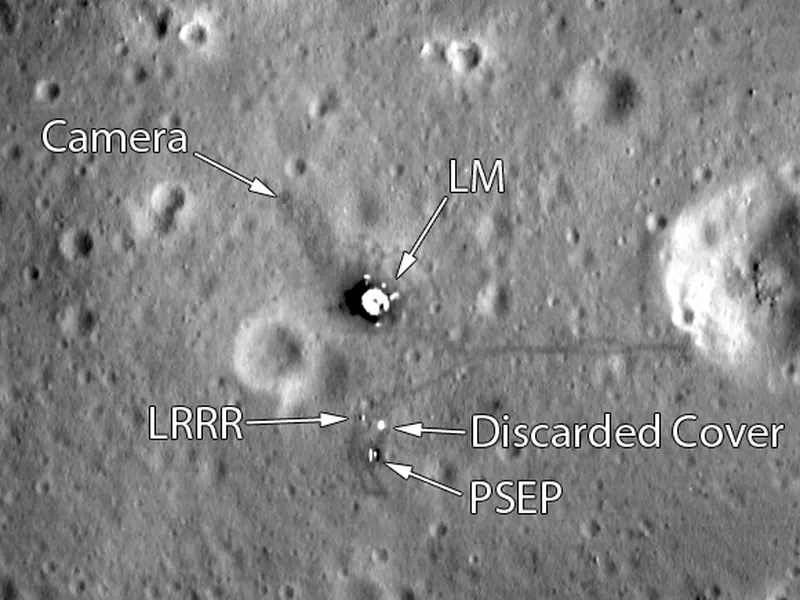
Myth Nobody can prove the astronauts left anything there.
Fact LRO has photographed the Apollo 11 landing site: the descent stage left behind is visible, and so are the trails of the astronauts’ footprints. NASA Science: Apollo 11 landing site, seen by LRO Apollo astronauts brought back 382 kg of Moon rocks and soil. Scientists are still studying them. NASA Science: Moon facts
Myth Spring tides only happen in spring.
Fact Spring tides (extra-high and extra-low) happen around new and full Moon, when the Sun, Moon and Earth line up. They’ve nothing to do with spring. NASA Science: Tides
Myth There’s no water at all on the Moon.
Fact There is water ice in permanently shadowed craters at the Moon’s poles, where sunlight never reaches. NASA Science: Moon facts In October 2020 NASA’s SOFIA observatory confirmed water on the sunlit surface of the Moon for the first time, in Clavius Crater. NASA Science: Moon facts